
Aluminum CNC Bridge Production
From Prototype to Scalable Manufacturing
Move successful aluminum prototypes into stable, repeatable production with a bridge manufacturing model built for low-to-mid-volume supply.
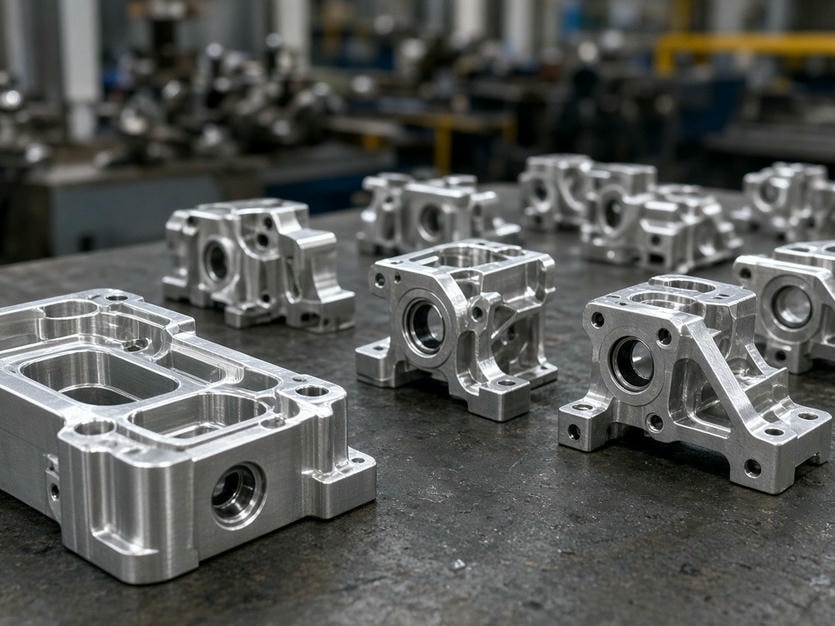
CNCALPARTS specializes in aluminum CNC machining, helping engineering and procurement teams transition beyond the initial 10-piece prototype phase through fixture optimization, process control, quality documentation, and production ramp-up.
1–10
Prototype quantities
10–500
Low-volume bridge runs
500+
Batch production
Material focus
Aluminum alloys
Production focus
Repeatable supply
The bridge production advantage
Build the process, not just the parts
Bridge production establishes a repeatable manufacturing system as a project moves past prototype validation. The result is greater consistency, shorter cycle times, and a clearer path to cost-efficient volume.
Fixture optimization
Move from flexible, low-cost setups to dedicated workholding that improves positional accuracy and reduces cycle times.
Process documentation
Standardized machining sequences help every part in a batch of 50 or 500 meet the same dimensional requirements.
Tooling strategy
Aluminum-specific tooling balances material removal rates, tool life, and production cost.
Deformation control
Stress-aware machining keeps thin-wall parts and complex housings within tolerance after machining.
Core capabilities
Configured for aluminum CNC production
Our 3-axis, 4-axis, and 5-axis CNC systems are configured for aluminum alloys including 6061, 7075, 6082, and 5052.
| Capability | Specifications |
|---|---|
| Machining Types | Milling, Turning, Turn-Mill, Multi-axis |
| Max Milling Envelope | 1000 × 600 × 500 mm |
| Max Turning Diameter | Ø300 mm |
| General Tolerance | ±0.05 mm |
| Precision Tolerance | Down to ±0.01 mm |
| Wall Thickness | Down to 0.5 mm |
| Surface Roughness | Ra 0.8–3.2 μm |
| Production Scale | Prototypes (1–10), Low-Volume (10–500), Batch (500+) |
Engineering for repeatability
Resolve production risks before the first chip is cut
We review 3D models and technical drawings to identify manufacturing issues before production begins. This engineering approach supports tight-tolerance components such as optical mounts, robotics housings, and manifold blocks.
Datum strategy
Consistent reference points for multi-sided machining.
Heat management
Temperature control during high-speed machining to limit thermal expansion errors.
Stress relief
Controlled material removal to prevent warping in thin-wall structures.
Dimensional stability
Consistent hole diameters, thread fits, and flatness throughout the run.
Quality control
Inspection integrated into the process
Production-level manufacturing requires more than a final inspection. Our protocols create traceability and help keep the process within control limits throughout the run.
First Article Inspection
Every feature on the first production units is verified to validate the process.
In-process monitoring
CMMs, height gauges, and micrometers support periodic dimensional checks.
Finish validation and reporting
Surface roughness testing, dimensional reports, and project-specific documentation support supply-chain traceability.
Surface finishing
Parts ready for assembly
We manage the transition from machining to finishing so the delivered components match functional and cosmetic requirements.
- Anodizing: Clear, black, color, and hard anodizing for corrosion resistance and surface hardness.
- Bead blasting: Uniform matte finishes that hide machining marks or prepare parts for coating.
- Brushing and polishing: Specific cosmetic finishes for consumer-facing or optical components.
- Powder coating: Durable, decorative, and protective layers for industrial environments.
Why focus on aluminum?
One material. One optimized workflow.
Many machine shops process steel, brass, titanium, plastics, and aluminum together. That can introduce cross-contamination and limit optimization for aluminum’s thermal and mechanical properties.
CNCALPARTS machines aluminum. Only aluminum.
This focus lets us refine cutting parameters, lubrication, tooling, stress management, and anodizing preparation specifically for aluminum alloys.
Common questions
Planning the transition to production
Start your bridge production project
Create a stable path from prototype to production
Share your aluminum part requirements with our team for a detailed manufacturing review and a practical path toward repeatable supply.
Ideal for robotics, automation, electronics, and industrial equipment.
Send STEP/STP files and technical drawings to info@cncalparts.com.
Request a review
Talk with an aluminum machining specialist
CNCALPARTS
Aluminum CNC Machining Specialists