
Precision Aluminum Plate Machining for Structural Components
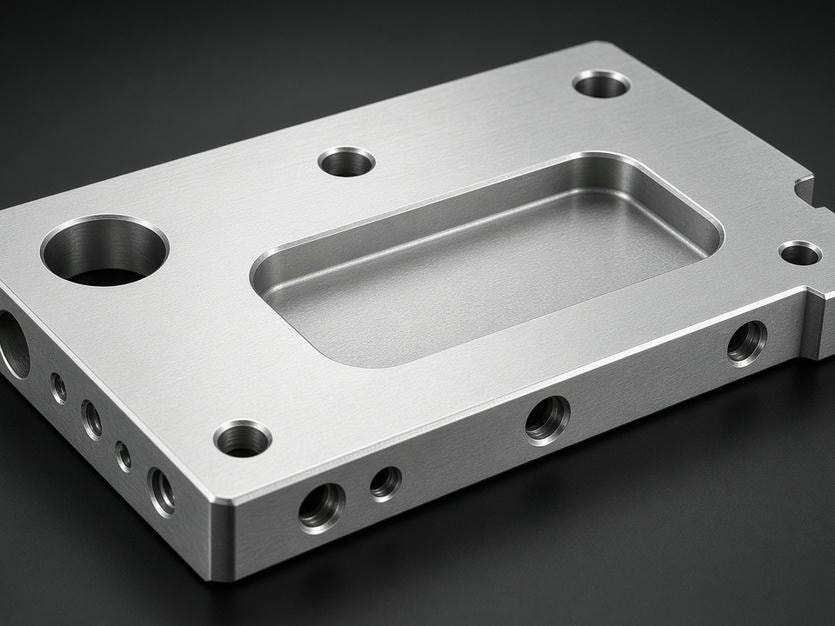
CNCALPARTS produces precision-machined aluminum plates, mounting bases, complex housings, and equipment structures for robotics, automation, and industrial manufacturers.
Our dedicated aluminum focus aligns tooling, workholding, cutting parameters, and thermal control around the material’s behavior. The result is more stable flatness, parallelism, hole positioning, surface quality, and repeatability.
±0.01 mm
Available tolerance
0.02 mm
Flatness and parallelism
1–500+
Prototype to production pieces
Focus
Large-area milling
Control
Stress and heat
Designed around aluminum
Controlling the variables that cause plate distortion
Large billets and plates can release internal stress during material removal. Aluminum also responds quickly to heat and clamping pressure. Our process is structured to protect the geometry of your finished component from roughing through final inspection.
Stress relief strategies
Specific roughing passes and sequential material removal allow plates to stabilize before critical finishing operations.
Uniform workholding
Fixtures support the part evenly and avoid clamping forces that can bend the plate and compromise final parallelism.
Thermal control
Calibrated cutting parameters, chip evacuation, and coolant flow help prevent thermal expansion from shifting hole arrays and cavities.
Core manufacturing capabilities
A consistent process from first article to final batch
We support prototype development and production-scale manufacturing for aluminum components used in equipment, automation, robotics, optics, and industrial systems.
Discuss your drawing requirements| Capability | Specification |
|---|---|
| Materials | 6061, 7075, 6082, 5052, and other aluminum alloys |
| Maximum milling size | 1000 × 600 × 500 mm |
| Tolerance | Down to ±0.01 mm |
| Flatness / parallelism | Down to 0.02 mm |
| Hole tolerance | Down to ±0.01 mm |
| Surface roughness | Ra 0.8–3.2 μm |
| Minimum wall thickness | 0.5 mm |
| Production volumes | 1–500+ pieces |
Complex plate features
Geometry that stays aligned across the assembly
We machine the feature relationships that matter in equipment structures, base plates, mounting systems, and precision housings.
Deep cavities
Efficient material removal while protecting wall integrity and minimizing deformation.
Precision hole arrays
Accurate positioning for bearing mounts, dowel pins, fasteners, and repeatable assemblies.
Tight-tolerance pockets
Consistent depth control for electronics, sensors, covers, and integrated subassemblies.
Multi-sided machining
4-axis and 5-axis capabilities improve the relationship between features on different faces.
Finishing options
Surface treatments matched to the application
Aluminum plates may need a clean functional finish, improved wear resistance, corrosion protection, or a controlled appearance. We provide in-house and managed finishing services.
- ●As machined: Clean, deburred surfaces for internal structural parts.
- ●Bead blasting: Uniform matte finish that removes machining lines and prepares surfaces for anodizing.
- ●Anodizing: Clear, black, and color options for corrosion resistance and wear protection.
- ●Hard anodizing: Increased surface hardness for demanding, high-wear applications.
- ●Powder coating and chemical film: Specialized environmental protection.
Quality assurance
Inspection built around your drawing and model
Every project is verified against the technical requirements needed for fit, function, and downstream assembly.
Dimensional verification
CMM inspection and precision height gauges confirm critical dimensions.
Geometric control
Flatness, parallelism, and position tolerances are checked rigorously.
Threads and bores
Calibrated thread gauges and pin gauges support reliable assembly fit.
Documentation
FAI reports and dimensional inspection reports are available upon request.
Why CNCALPARTS
A single-material focus for more predictable results
We do not machine steel, titanium, or plastics. We machine aluminum, and only aluminum. That specialization helps us maintain stable, repeatable production cycles for recurring orders.
01
Process consistency
Machines, tooling, and cutting parameters are dialed in for aluminum alloys, reducing setup variation and cross-contamination risk.
02
Engineering expertise
We understand the behavior of grades such as 6061 and 7075 and can advise on DFM, cost, and part performance.
03
Production reliability
A focused material category supports repeatable cycles and consistent quality across prototype and recurring production orders.
Project guidance
Send your files and start with a technical review
We work with engineering and procurement teams in robotics, automation, optical, and industrial sectors. Share your requirements for aluminum plates, bottom plates, mounting plates, or structural housings.
Recommended project files
Include alloy, quantity, finish, critical flatness or parallelism requirements, and any inspection documentation needs.
Request a quote
Let us review your aluminum machining requirements
Send your project files to info@cncalparts.com, or use the contact path below to discuss your specifications and technical requirements.
CNCALPARTS
Aluminum CNC Machining Specialists
Email: info@cncalparts.com
Technical questions
Common questions about aluminum plate machining
How do you reduce warping in large aluminum plates? +
We combine sequential roughing, controlled material removal, uniform workholding, and carefully managed finishing passes so internal stress can release without compromising the final geometry.
Can you maintain flatness and parallelism on mounting plates? +
Yes. Workholding is designed to support the part evenly and avoid bending forces. Flatness and parallelism can be controlled down to 0.02 mm, depending on part geometry and requirements.
Which aluminum grades can you machine? +
Common materials include 6061, 7075, 6082, and 5052. Share the required alloy with your drawing so the process and finishing recommendations can be reviewed accurately.